
Net Industrial Rents Declining Since the 2021–2023 Peak
After reaching a historic high between 2021 and 2023, net industrial rents in Québec are now showing a measurable decline.
According to the latest market reports, the average asking net industrial rent in Greater Montréal stands at around $14.00/sq. ft./year at the end of 2025, down for an eighth consecutive quarter.
On an annual basis, some submarkets have recorded corrections of up to approximately 15%, particularly in East Montréal. This trend confirms that the levels observed in 2022–2023 represented a cyclical peak driven by an exceptional shortage of supply.
Large Industrial Spaces Returning to the Market
One of the main drivers of the current shift is the return of large industrial spaces to the market, particularly in the segment of buildings of 100,000 sq. ft. and more.
In 2025, the Greater Montréal industrial market posted negative net absorption of approximately 2.7 million square feet, meaning more space was vacated than absorbed by tenants. This marks the third consecutive year of negative absorption, a phenomenon not seen since the 2009 financial crisis.
Amazon Vacancies and Pressure on Large Formats
The logistics consolidation of major e-commerce players, including Amazon, has contributed to bringing several million square feet of industrial space back to the Québec market.
These distribution centers, often ranging from 500,000 sq. ft. to more than 1 million sq. ft., were virtually nonexistent on the market between 2021 and 2023. Their return is putting direct pressure on rents for large spaces, particularly for single-user buildings.
Migration Toward Higher-Quality Industrial Buildings
Despite rising availability, demand remains highly targeted.
Buildings offering clear heights of 32 feet and more now represent nearly half of the total volume of available space, a direct result of an oversupply of recently delivered Class A product.
However, this segment shows a vacancy rate of approximately 18%, creating unprecedented negotiation opportunities for tenants seeking modern, high-performance buildings.
Automation, AI, and Robotics: A Structural Factor
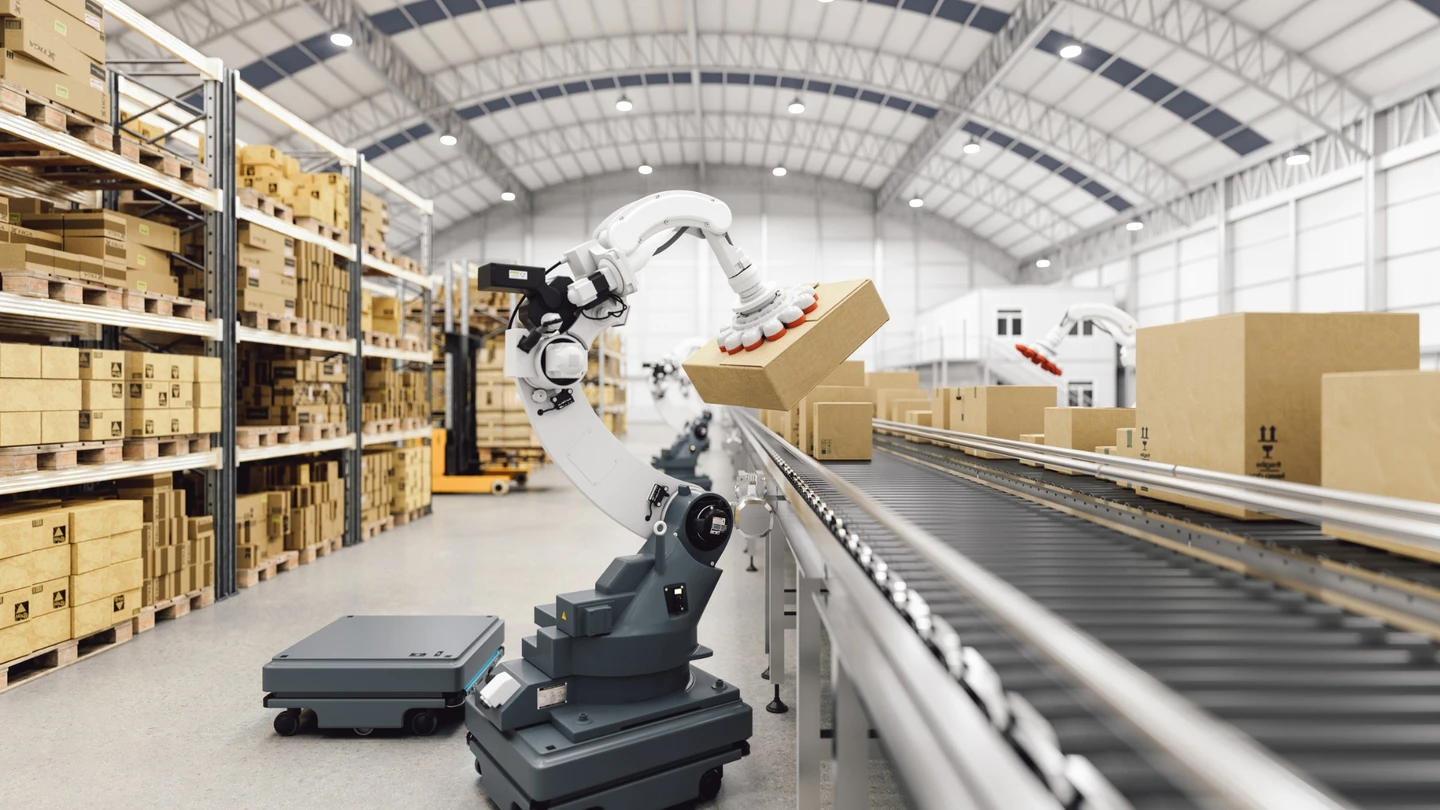
The automation of distribution centers has now become a structural factor in the industrial market.
Faced with labor shortages and rising wage costs, more and more companies are integrating robots, intelligent conveyors, and AI-driven systems to reduce operational payroll while improving productivity.
This evolution is also transforming space utilization. Buildings with clear heights of 32 feet and more allow companies to leverage vertical storage through automation, increasing operational capacity without necessarily increasing leased square footage.
These efficiency gains explain the market polarization:
- older or hard-to-adapt buildings are experiencing downward pressure on rents;
- modern, automation-ready buildings remain in demand, but without the extreme premium observed between 2021 and 2023.
Concrete Opportunities for Tenants in 2025–2026
With an industrial availability rate of approximately 6% to 7% in Greater Montréal, the market now offers a level of choice rarely seen in more than a decade.
Tenants can now:
- access spaces of 100,000 sq. ft. and more,
- negotiate net rents below 2022–2023 levels,
- obtain more flexible terms, including incentives and free rent periods.
2026 Outlook: A More Balanced but Selective Market
Current indicators suggest that 2026 should mark a phase of gradual stabilization, particularly if demand catches up with supply in the high-quality building segment.
Companies that act during this transition phase will be able to secure strategic space under favorable conditions before a potential return to an upward cycle.